Future Shock!
What will archaeology look like in ten years’ time?
As a kid growing up in the 1980s I was obsessed with a coffee table publication called the Usborne Book of the Future – first published in 1979 and recently reissued by Usborne with its original text and artwork (usborne.com). The wildly imaginative illustrations brought an exciting technology-driven future to life on every page, covering all aspects of daily life that future technology and automation might touch. While the presentation was enthusiastically positive about the exciting world it depicted, there were oblique hints at an alternative dystopian future should the technology be mismanaged.
In their chapter ‘Man and machine – partners down the future ages’ Usborne depicted a team of Star Wars-style droids working alongside a human dressed in a space suit, set against a red planet landscape with a starship hovering above. The chapter predicted ‘the prospect of intelligent machines should be little cause for fear. A man / machine partnership, each doing what it is best at, is more likely than that of mad robots taking over the world’. Having introduced the outside possibility of mad robots going rogue, the chapter goes on to explain the accompanying illustration of the starship, the droids and the astronaut in the following terms: ‘the humans are “in charge”, though the starship’s electronic brain has more capacity than the brains of all its human crew put together, and would probably override (or at least query) any orders it disagreed with’.
I find it fascinating that as far back as 1979, decades before the arrival of generative AI, there was already a latent fear that the machines we create might become smarter, might over-ride us and could possibly go rogue. This book has regularly come to mind over the last year as the reality of AI has intruded further and deeper into our lives. The excitement of such powerful new capabilities coupled with the simultaneous fear that it could wreck our careers, our lives and tear at our social fabric. No longer theoretical, but here and now.
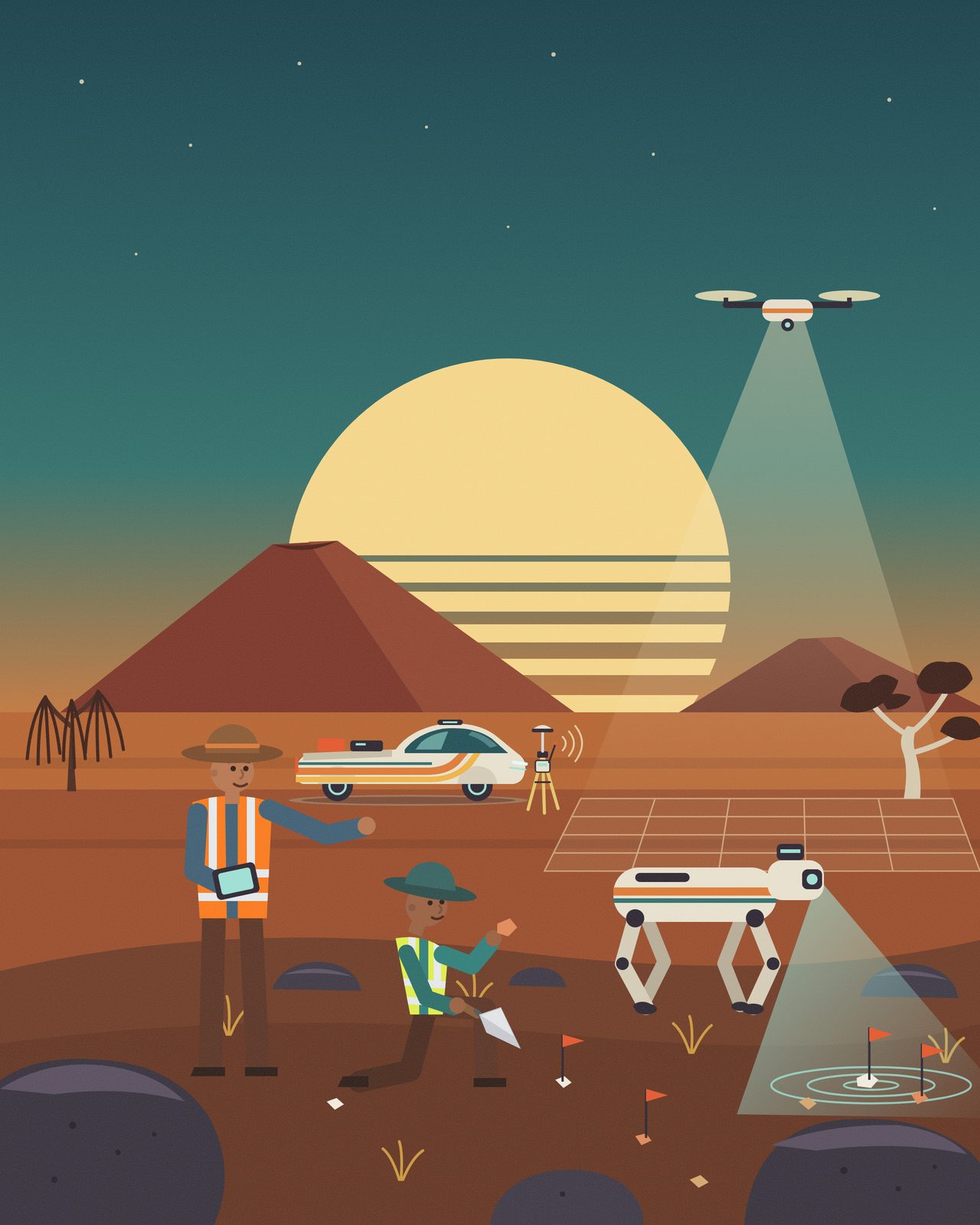
This got me thinking – what is our own little corner of the world in archaeology going to look like in ten years’ time in the face of this technology-driven upheaval? This month’s chapter of History Journeys Detours takes a deep breath and makes some speculative predictions about how it could all play out in archaeology over the next decade.
New capabilities and methods
There is technology available now and technology that is coming in the near future that provide clear pointers to capabilities and methods that will be widely used in the next decade.
Desktop research
Large Language Models (LLMs), working with machine learning and GIS tools, have high-level capabilities to collate and summarise literature, synthesise data, compile environmental background information, develop predictive models and to deliver first drafts of whole report sections. They also have the capacity to analyse massive datasets, potentially entire statewide site register and grey literature report archives and then synthesise that data (for example, see the Dutch AGNES project – a machine-learning search engine used to mine an archive of about 60,000 Dutch excavation reports; Brandsen 2022). They can run big data analyses that are simply beyond any realistic human capacity. There is the potential that crunching such large datasets may reveal significant new insights about the past and they could offer us a more detailed and accurate understanding of site patterning to identify and control for biases in the record.
While the open slather use of LLMs for this kind of work is problematic from an ethical and legal standpoint, there is no doubting they offer capabilities that save significant time, money and resources. Given these benefits on offer, I suspect it is only a matter of time before solutions will be found that can effectively ‘sandbox’ culturally sensitive data and ensure Traditional Owner IP is protected. The Maiam nayri Wingara Indigenous Data Sovereignty principles and the CARE Principles for Indigenous Data Governance provide a set of principles as a starting point and a great example in practice is the Budj Bim 2019–20 LiDAR capture dataset (Land Use Victoria 2024) which is fully owned and controlled by Gunditj Mirring Traditional Owners Aboriginal Corporation.
In ten years’ time I expect we will see machine drafted desktop research, literature reviews and predictive modelling as the norm, assembled by AI and then (hopefully!) reviewed and checked by experienced archaeologists.
Survey
The disruption is likely to extend into archaeological survey, prospection, recording and mapping work. Remote sensing methods using LiDAR, multi-spectral and Remotely Piloted Aircraft (RPA) derived data are already being deployed with significant success. The price to acquire this technology is coming down fast, as is the simplicity of use, effectively removing the barrier to entry and bringing these methods within reach of individuals and small practices.
Currently these methods can be used to find and map stone arrangements, mounds, hearths, channels and stone footings – including, in the case of LiDAR, beneath heavy vegetation cover. They offer high resolution digital terrain mapping that assists with detailed landscape mapping and provides scope for highly nuanced predictive modelling.
The coming capability will extend to the identification and mapping of individual stone artefacts on exposed ground surfaces using RPAs equipped with onboard RTK positioning and high-definition aerial photogrammetry. This capability has already been used to map potsherds (Orengo and Garcia-Molsosa 2019; the follow-on TrackSherd project) and its application to finding stone artefacts is the subject of a current PhD scholarship on offer at Flinders University. The use of deep learning tools and AI can automate the process of feature detection across large imagery and DEM datasets.
While the technology is not quite there to use RPAs to achieve detailed recording of individual surface artefacts in a way that can identify features and diagnostic traits, there is emerging technology that may automate that work too. All-terrain robotic quadrupeds have hit the market, and some can carry LiDAR and camera payloads – from low-cost models such as the Unitree Go2 to Boston Dynamics’ Spot, which has carried a Leica laser scanner around Pompeii.
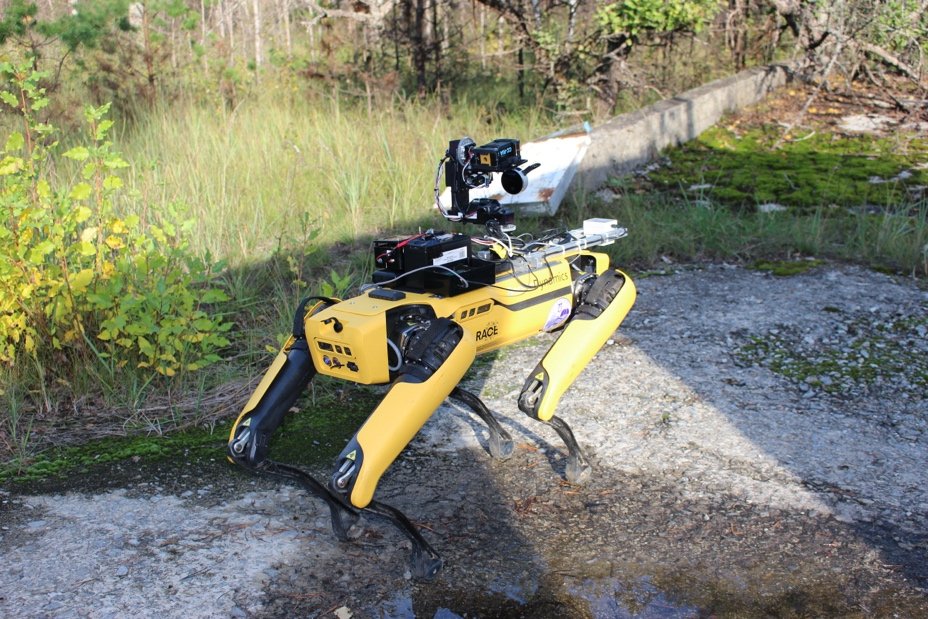
There is a near future likelihood that archaeologists will deploy robot dogs equipped with LiDAR heads that can tirelessly and systematically survey an area of land. This sort of technology opens up the future prospect that archaeological survey could be achieved largely without humans. Perhaps with a workflow comprising initial high level RPA mapping to identify exposed surface artefacts or potential artefacts, followed up with a detailed recording phase using robotic quadrupeds or other ground-based automated methods. That would raise hard questions, not least for Traditional Owners, given the importance of physically walking Country to identify, assess and articulate cultural values of the landscape. The better version of this future would see the robot walking with people rather than replacing them.
Excavation and recording
Thankfully it would seem excavation is one area that will remain mostly human in ten years’ time. It is unlikely robotics will be capable of excavating deposits with a spade, trowel and coal shovel within that timeframe. It might be possible to envisage autonomous mechanical excavator and mechanical sieve processes, but my sense is the cost in ten years would still be prohibitive relative to the costs of hiring archaeologists and machine operators. There will also be an ongoing need for archaeological expertise to monitor and guide automated excavation equipment.
The world of automation is likely to enter into recording methods and post-excavation work too. It is likely that GIS mapping and visualisation work will largely be AI driven within the next decade, similar to the emerging practice of ‘vibe coding’ in the IT industry. This may put sophisticated mapping and spatial analysis capabilities in the hands of everyday archaeologists, without reliance on specially trained spatial analysts. Field recording of trenches and profiles will likely be done using RTK supported georectified photogrammetry methods, replacing the old world of string line, line levels and permatrace drawings. Stone artefact cataloguing and analysis may well become automated, and other analyses such as sedimentology, dating, palynology and emerging fields like ancient DNA are likely to become easier to do, cheaper and quicker. There is a potential these analyses will become commonplace and incorporated as standard methods.
How will this affect our work lives?
In our near future as archaeologists there will be fewer people doing routine desk work, more data and capabilities at our fingertips, and we as a profession will have to decide whether to use that abundance for cheaper compliance or for better research.
Much depends on the guardrails and ethics that are put in place, particularly in the next year or two. There is a sunlit uplands scenario where automation is adopted when it adds value to the quality of our research, that it is managed in a way that maintains Traditional Owner IP and ensures data security for confidential information, and it is closely supervised, reviewed and verified by experienced archaeologists. A bleaker alternative might see business and government reaching to maximise the cost and time efficiencies on offer by automating whole workflows and simply making people redundant. Either way, it is likely that the buck will still need to stop with archaeologists who will need to take legal responsibility for advice and be accountable for compliance approval processes.
One of the main concerns I have in this emerging world of automation is where the next generation of experienced archaeologists is going to come from. How do we train and grow a new generation if we automate desktop research, survey work, modelling, analysis work? And what sort of archaeologists are we talking about when universities are adopting ‘AI-first’ positioning? Are future archaeologists simply pressing buttons on automated systems and providing manual labour to excavate trenches under instruction from AI? If this is how it plays out, how will we develop archaeologists with the necessary experience and expertise to review and vet machine generated outputs?
A second concern is that the new capabilities will tend to lead to more standardisation and centralisation. Experience suggests that time saved through efficiencies is generally used to lower fees and produce higher volume. Efficiencies could provide for more thinking time and deeper research, but the economic incentives will likely push in the direction of cost and time savings. The automation of modelling may lead to regulators centralising the process and using it as a gatekeeper that decides when and where archaeological work gets done based on modelled sensitivity. My fear is we could see a future where reports and research converge into a narrow lane where everything is homogenised and distinctive arguments or left-field thinking are triaged out.
There could be a future in ten years’ time where archaeological skills and critical thinking fade from disuse, as people stop checking what the machine produces for them and the incoming generation lack the skills and experience to even be able to check.
In a better reality we could use automation with care and in a calibrated manner, with strong guardrails and ethical standards in place. We could opt to use the new capabilities to be ambitious – to free up our capacity to devote more time to synthesis and higher quality research work. It will be critical that Traditional Owners, government heritage authorities and the industry itself push for this future if we want it to become our reality.
There could be upsides if we do this well. Individual archaeologists and small firms will be able to access capabilities and methods that were once out of reach, putting them on a competitive footing with large firms and tertiary institutions. Traditional Owners may be able to exercise more control over their cultural heritage – as the Gunditjmara have done at Budj Bim. Exciting new interpretation and storytelling will be possible through augmented reality, visualisation and digital twins. Analysis of big datasets will open up new horizons and help us explore regional scale research questions that have been out of reach. The need for repetitive and boring admin and record transcription work will be reduced.
There are lots of conversations happening right now about how we shape our future as a profession. In the last month alone there has been a practice note on AI issued by First Peoples – State Relations (Department of Premier and Cabinet, Victoria) and the Australian Association of Consulting Archaeologists Inc. (AACAI) has established a sub-committee to develop an industry-led policy on AI. These are early moves in a process that will be critical in determining what our profession looks like in the 2030s.
And a final left-field thought – I wonder if in time there will be those that completely reject any automation in their work. The emergence of a group of people who view archaeology as a craft and archaeologists as artisans, where ‘handmade’ reports that include hand-drawn plans, artefact drawings and old analogue and manual methods are used. I have no idea how this kind of archaeology would be funded, but I can definitely see a future where a new generation of archaeologists look to rediscover the craft of ‘doing’ archaeology for its value as a human process of discovery rather than simply an output in a compliance system.
References
- Brandsen, A. 2022. Digging in Documents: Using Text Mining to Access the Hidden Knowledge in Dutch Archaeological Excavation Reports. PhD thesis, Leiden University. hdl.handle.net/1887/3274287
- Carroll, S.R., I. Garba, O.L. Figueroa-Rodríguez, J. Holbrook, R. Lovett, S. Materechera, M. Parsons, K. Raseroka, D. Rodriguez-Lonebear, R. Rowe, R. Sara, J.D. Walker, J. Anderson and M. Hudson. 2020. ‘The CARE Principles for Indigenous Data Governance’, Data Science Journal 19(1):43. doi.org/10.5334/dsj-2020-043
- Farrell, T. 2026. ‘Embracing AI responsibly’, statement by the Vice-Chancellor, La Trobe University, 16 July 2026. latrobe.edu.au
- First Peoples – State Relations. 2026. [Title of AI practice note to be confirmed]. Department of Premier and Cabinet, Victoria.
- Flinders University. 2026. ‘PhD Scholarship: Automated Detection of Archaeological Features Using Drone Imaging’. flinders.edu.au
- Gatland, K. and D. Jefferis. 1979. The Usborne Book of the Future: A Trip in Time to the Year 2000 and Beyond. London: Usborne Publishing. Reissued 2023 as Book of the Future, with a foreword by Tom Cheesewright. usborne.com
- Global Indigenous Data Alliance. 2019. CARE Principles for Indigenous Data Governance. gida-global.org
- Institut Català d’Arqueologia Clàssica. n.d. ‘TrackSherd: Towards an Automated Archaeological Surface Survey’ (2020–2022). icac.cat
- Land Use Victoria. 2024. ‘Budj Bim LiDAR 2019–20’. land.vic.gov.au
- Maiam nayri Wingara Indigenous Data Sovereignty Collective and Australian Indigenous Governance Institute. 2018. Indigenous Data Sovereignty Communique. Indigenous Data Sovereignty Summit, Canberra, 20 June 2018. aigi.org.au
- Orengo, H.A. and A. Garcia-Molsosa. 2019. ‘A brave new world for archaeological survey: automated machine learning-based potsherd detection using high-resolution drone imagery’, Journal of Archaeological Science 112:105013. doi.org/10.1016/j.jas.2019.105013
- Parco Archeologico di Pompei. 2022. ‘SPOT, a quadruped robot at the service of archaeology to inspect archaeological areas and structures in safety’. pompeiisites.org
- Unitree Robotics. n.d. ‘Unitree Go2’. unitree.com
AI Use Disclosure: This article has involved minor use of AI. Claude Opus 5.5 was used to proofread the draft, provide comments and recommended corrections, and it was used to check and locate some references, sources and facts. Opus 5.5 was also used to generate the future archaeology illustration. The article was written by me and is my work.