Torre de Hércules — A Coruña, Galicia, Spain

We start our detours with one of my all-time favourite heritage places.
For a UNESCO World Heritage property, the Torre de Hércules sits strangely off the radar. So much so that when we ran a ‘guess the world heritage site’ photo competition at the recent World Archaeology Congress 10 in Darwin, less than one in ten archaeologists correctly recognised the place.
Perhaps its location in the far north-west corner of Spain means it does not receive the attention it deserves, or perhaps it is such an unusual place that it defies easy translation into a tourism brochure. Either way, it sits well outside the top twenty visited historical monuments in Spain – attracting around 125,000 visitors annually, most of whom are Spanish domestic tourists. By comparison, the former Moorish palace of the Alhambra in Granada attracts close to 3 million visitors each year.

A Roman survivor
This is a pity, because the Torre de Hércules is one of the most extraordinary historical and archaeological sites in the world. For starters, it is the oldest continuously functioning lighthouse in the world – by some distance. It is the only Roman pharos still in use for maritime signalling, first raised in the late first or early second century CE at Brigantium (modern-day A Coruña). It is easily the most impressive and intact of the three remnant Roman lighthouse structures still in existence, the others being the remains of a smaller octagonal tower in Dover, UK, and the footings of the Leptis Magna pharos in Libya.
The Torre de Hércules stands as a physical remnant of the complex system of maritime navigation that supported extensive trade networks throughout the Roman world during the early imperial period. The design was inspired by earlier Roman lighthouses such as the Claudian-era Portus lighthouse in Ostia, which in turn was inspired by the Pharos of Alexandria, one of the so-called ‘seven wonders of the ancient world’. The extent of lighthouse construction in the Roman world is not entirely clear, though it is considered likely they were a key feature of every major Roman port.

How it was built
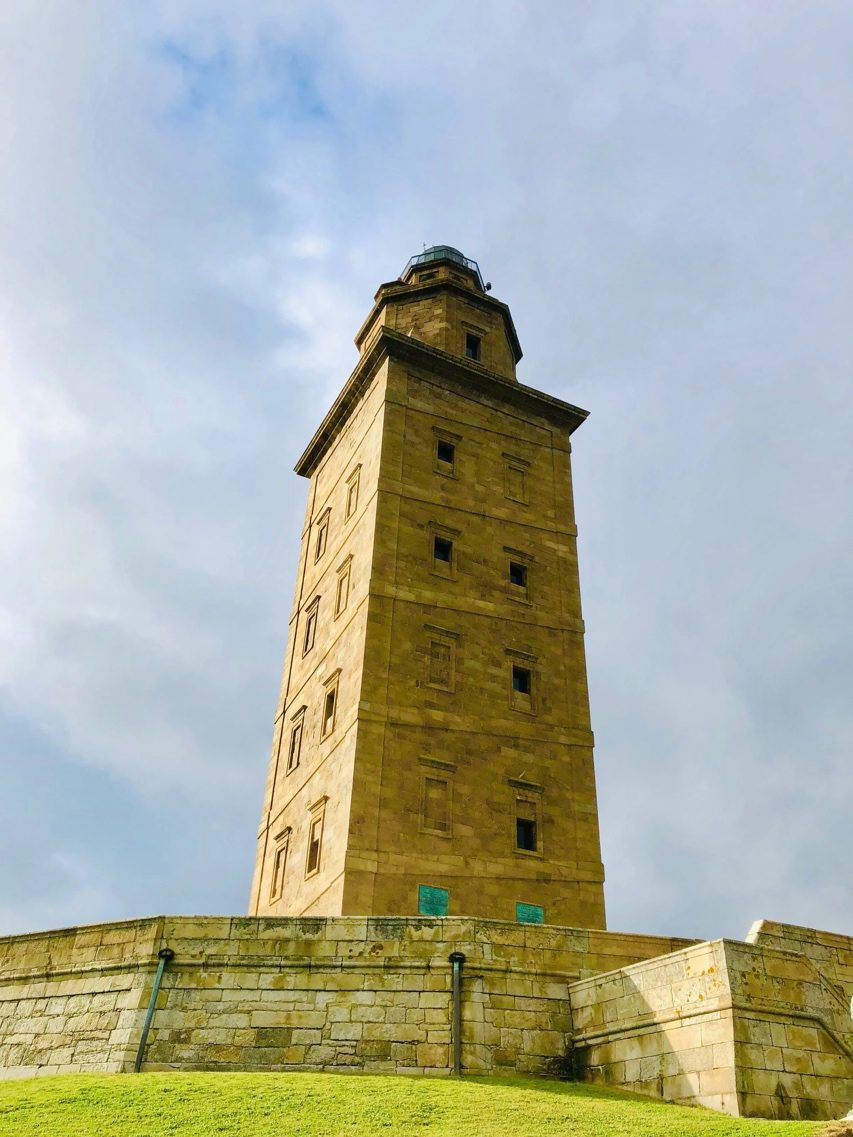
Archaeological excavation in the undercroft and footings of the lighthouse podium has revealed much detail about the phases of construction and use of the lighthouse over 2,000 years. A rock-cut dedication at the foot of the tower to Mars Augustus credits the architect Gaius Sevius Lupus of Aeminium (modern Coimbra) with the design. The surviving Roman fabric forms a square core of large granite ashlar, comprising three uneven storeys — each with barrel-vaulted ceilings.

Excavations in the early 1990s cast new light on how it originally functioned. Fragments of an outer perimeter wall and iron fixings demonstrated that the granite core was once wrapped by an external helicoidal (spiral) ramp, likely used to transport wood to the summit, where a domed structure served as a fire room and beacon for shipping approaching the port of Brigantium. Over time, the ramp and external perimeter wall were lost and the tower decayed, but there is evidence of repairs and continued use during the medieval period — likely as a fortress or stronghold. Its definitive transformation came with the neoclassical restoration of 1788–1791, which encased the Roman core in the present granite shell, raised the total height to about 55 m, and added the diagonal spiral band that still runs up the façade in deliberate memory of the vanished Roman ramp.

From ruin to restoration
The late-18th-century restoration is itself a superb piece of architecture and an interesting early example of heritage conservation and interpretation, where significant effort was made to preserve and interpret an original ancient structure. The 18th-century lighthouse superstructure, encasing the ancient Roman core, is also significant as an early example of a modern lighthouse in its own right.
The lighting apparatus was modernised in step with technology — a coal brazier after 1790, a rotating mechanism and catadioptric (glass-reflector) system in the nineteenth century, and electrification in 1927. The monument was inscribed as a UNESCO World Heritage Site in 2009 in recognition of its outstanding universal values.
The tower of Breogán
The Tower of Hércules also plays a somewhat unexpected starring role in a key chapter of Irish medieval mythology. According to the Irish medieval pseudo-history the Lebor Gabála Érenn, Íth, the son of the legendary King Breogán of Galicia, glimpsed a far-off green land from the top of his father’s mighty tower and travelled to Ireland with a party of adventurers. After a series of misadventures, the descendants of King Breogán, the ‘Milesians’, eventually conquered the old peoples of Ireland — the Tuath Dé Danaan. The Tuath Dé were consigned to live underground as the Aos Si, who eventually came to be known as the Faeries. While it is unlikely the medieval chroniclers of the Lebor Gabála Érenn had direct knowledge of the Torre de Hércules, it is likely the story of King Breogán’s tower was inspired by Paulus Orosius, a Galician priest writing in CE 415 in his Seven Books of History against the Pagans, who describes ‘a most high tower’ at Brigantia built to keep watch toward Britain, and notes that the nearer parts of Ireland ‘look toward’ it across the sea.
Although the Lebor Gabála Érenn has long been considered a concocted origin story with no historical basis, an ancestral link between north-western Spain and Ireland is still a fairly widely held belief in Ireland and parts of Spain to this day, as the statue of King Breogán near the entrance to the Torre de Hércules attests.

Why it matters
The Torre de Hércules is one of the finest examples of an historic place that has multi-layered historical, archaeological, technical and social significance values. These combine to form a rare and compelling place with outstanding universal value. It is a great example of a heritage place that requires a multi-disciplinary and multi-focal lens, bringing together historical research, archaeological excavation and analysis, comparative technical studies and an understanding of the social values of this place in the mythology, storytelling and identity construction of modern-day communities in Galicia and as far afield as Ireland.
This picks up on a common theme I will be following in future ‘Detours’, highlighting the value in applying a multi-disciplinary and multi-stranded approach to understand the range of values embedded in cultural places and landscapes. Widening the lens to accommodate the diverse values of a place can open up new insights and provide a richer appreciation of our past. It also provides a more solid foundation for how we manage and interpret significant places.